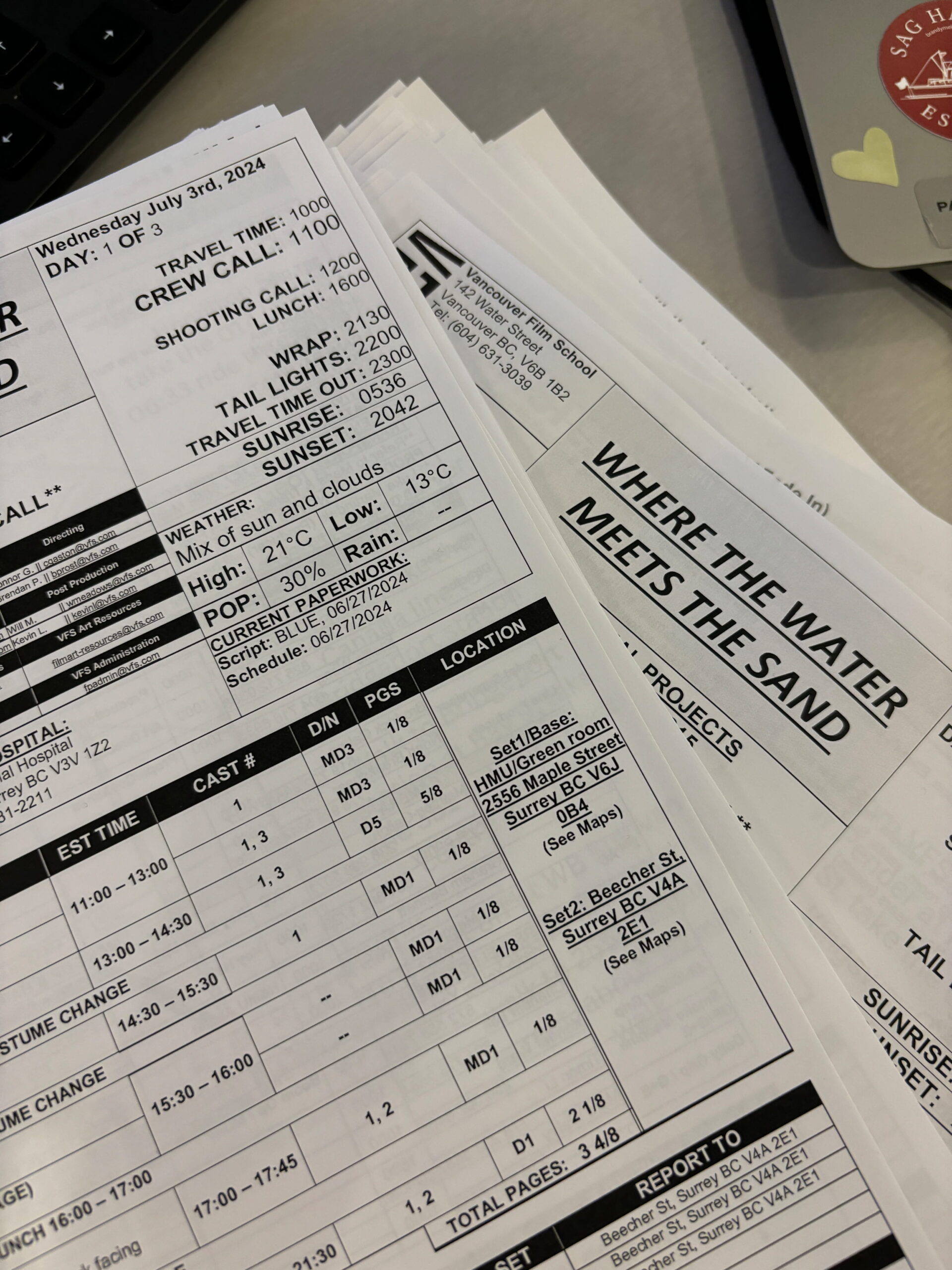

Photographed by Steffie Wong. Used with permission.
Every great film begins with a spark of creativity - a script filled with high-stakes drama, witty dialogue and visual sequences. As a producer, you look at that same script and see something entirely different: a giant puzzle of logistical variables, financial obligations, and calendar conflicts.
The script breakdown is the exact moment a film transitions from an artistic concept into a physical reality. It is the process of stripping a story down to its raw operational elements so you can build an air-tight production. If you want to pull a story out of a writer's head and put it onto a screen without burning through your budget, here is a framework on how to get it done!
Step 1: The Macro Read
Before looking at details, a producer reads the script to determine the financial and logistical scale of the project. You are not counting props yet; you are asking big-picture questions. "Is this a single-location indie drama or a multi-location action piece?" "Does it require heavy VFX?" This initial pass sets the baseline for your financial boundaries.
Step 2: The Collaborative Hand-Off
Once the creative scope is understood, you collaborate with the 1st Assistant Director (AD). The AD department handles the mechanics of the script, and breaking the scenes down into eighths for scheduling pace. As a producer, you act as the receiver of this information, ready to ingest the raw data into your financial models.
Step 3: Translating Elements into Line Items
Taking the AD's breakdown data, you start translating physical needs into hard cash. You are effectively turning a list of creative ingredients into a realistic cost project.
Step 4: The Optimization Puzzle
With your budget parameters set and the AD's scheduling in hand, you come back together with the AD to build the master production board. You don't shoot chronologically; you shoot efficiently. You look at the data to find financial wins: grouping scenes by location to avoid expensive company moves or staking an actor's scenes back-to-back so you can wrap them early and save on their daily rates.
An interesting read, I always wondered why films weren’t shot in chronological order, and of course you would want to be as efficient as possible. This sounds like such an interesting career, can’t wait to read more.
Your article was such a great learning – I had no idea that the shooting of a film is based on efficiently which makes total sense. Thanks for the insider scoop!